Org Mode in the AI Era: Organize Your Life in Plain Text, Then Automate It

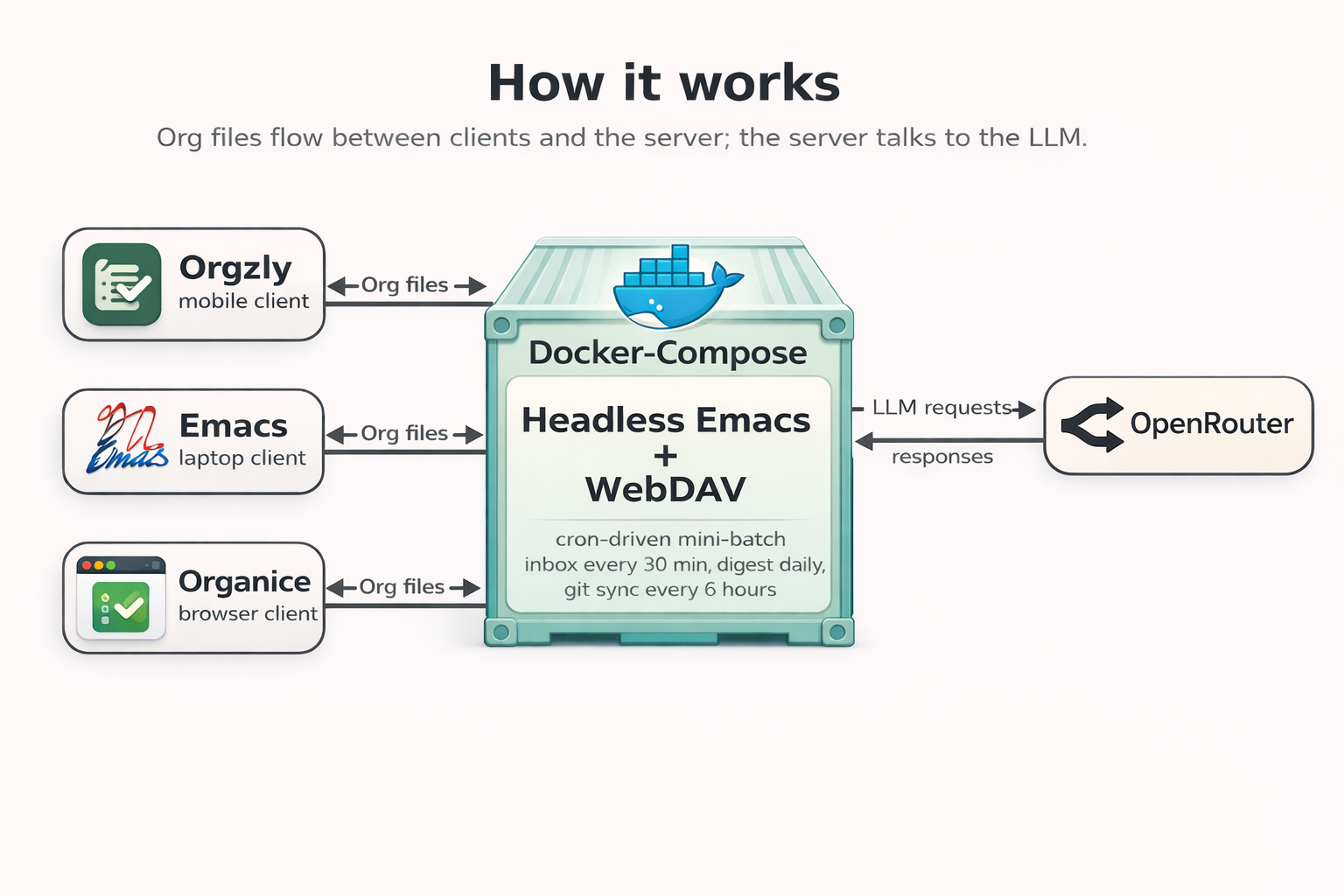
Yes, I really ended up running headless Emacs in Docker Compose. Yes, it actually works. And yes, in this blog post I will explain why I think this setup makes much more sense than it sounds. I will start with the format question and why Org Mode still looks like the strongest plain-text foundation for combining notes, TODOs, scheduling, digests, and second-brain workflows. Then, I will explain why Emacs was chosen not just as an editor, but as the backend runtime for reliable Org processing and as the orchestrator for LLM-based automation. Finally, I will describe the two roles AI plays here. It is part of the system itself, but only inside carefully bounded workflows, and it is also the reason I could realistically build this kind of strange personal infrastructure in the first place. This project is not a product, not a SaaS, and not a generic framework. It is software for one user, built around one user’s workflows, from open-source pieces like Org Mode, gptel, and Elfeed. What changed in the AI era is that this kind of narrow, deeply personal software became much more realistic to build.
April 15, 2026 · 31 min · Sem Sinchenko

Why I (Still) Use Aider in 2026: Code Ownership, OpenSpec, and the Vibecoding Hype

In this blog post, I will share my thoughts on the current hype around "agentic coding" and why I still use Aider for human-in-the-loop pair programming in 2026. I will start with a top-level overview of the "vibecoding" trend and why generating thousands of lines of code with autonomous agents creates a massive code ownership crisis. Then, I will focus on the reality of maintaining existing OSS projects and why blind AI pull requests are a technical debt trap. Finally, I will explain why the industry needs a standardized approach to define boundaries for LLMs, and how reviewing structured formats like OpenSpec can be a better alternative to reviewing raw AI-generated code.

March 10, 2026 · 13 min · Sem Sinchenko

Generating docstrings with GPT

Generating Python docstrings with GPT and Emacs Motivation There is an open source library in which I'm a maintainer. And recently I committed to creating docstrings for all the public functions and methods. I heard that recent Large Language Models (LLM) are good enough in the annotation of texts and documenting of code so I decided to try to use one of OpenAI models to solve this problem. In this post I will use Emacs plugins and extensions to generate docstrings but most advises about which prompt is better to use are generic and may be used with different code editors and IDE's. ...

April 6, 2023 · 5 min · Sem Sinchenko